Why gummies are the fastest-growing supplement format in India
Ten years ago, most Indian consumers took vitamins as tablets or capsules. Today, gummies are one of the most requested formats among new supplement brands. They taste good, they are easy to take every day, and people who dislike swallowing pills are happy to take them.
For a brand, this means better repeat purchases. A product people enjoy taking is a product they buy again. That is why D2C brands, pharmacies and wellness startups are adding gummies to their range, from multivitamins and biotin to vitamin D3, apple cider vinegar, melatonin and kids’ nutrition.
But gummies are also one of the hardest formats to manufacture well. Active ingredients must stay stable in a moist, sweet base. Every gummy must hold the same dose. Texture, taste and shelf life all have to work together. For most brands, building a gummy line in-house makes no sense. Working with an experienced gummy manufacturer in India is the faster and safer route.
Private label, third party and contract manufacturing: what is the difference?
These three terms are often used together, and the models overlap. Here is the simple difference:
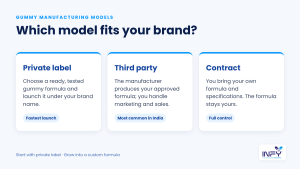
- Private label:you choose a ready, tested formula from the manufacturer’s range and sell it under your brand name. It is the fastest way to launch, often in 6 to 8 weeks after artwork approval.
- Third party manufacturing:the manufacturer produces your product under your brand, usually from a formula you approve, and you handle marketing and sales. This is the most common model in India.
- Contract manufacturing:you bring your own formula and specifications, and the manufacturer makes the product exactly to them. The formula stays yours.
Most brands start with private label to test the market, then move to a custom formula once they know what sells.
Why pectin-based vegetarian gummies?
The base decides who can buy your product. Many gummies sold worldwide use gelatin, which is animal-derived. That rules out vegetarian, vegan and many religious-diet customers, a large share of buyers in India and the Middle East.
Pectin comes from fruit, so pectin gummies are 100% vegetarian and carry the green veg mark on the label. They also hold their shape better in warm climates, which matters when shipping across India and to export markets. For a brand selling in India, a pectin base is the safest choice.
Two variants: sugar base and sugar-free
Pectin gummies are made in two variants:
- Sugar base:the classic gummy. It tastes great and is the most economical, so it suits mass-market multivitamins, kids’ gummies and everyday wellness.
- Sugar-free:sweetened with polyols such as maltitol or sorbitol instead of sugar. It suits fitness, weight-conscious and diabetic-aware buyers. It costs a little more per gummy, and under FSSAI rules the label must carry the polyol advisory.
What can go into a gummy?
A single gummy weighs about 3.5 to 4 g. That limits how much active ingredient fits into one piece. Popular gummy formulas in India include:
- Multivitamin and multimineral (adults and kids)
- Biotin, zinc and vitamins for hair, skin and nails
- Vitamin D3 and vitamin C for daily wellness
- Apple cider vinegar
- Melatonin and ashwagandha for night-time routines
- Omega-3 and DHA blends
If a formula needs more actives than one gummy can hold, a good manufacturer will recommend 2 gummies per serving instead of an oversized piece.
The gummy manufacturing process, step by step
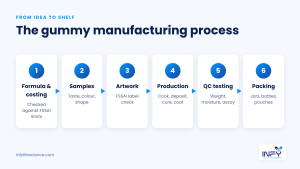
- Formulation and costing:the manufacturer checks every ingredient against FSSAI limits and prepares a quotation.
- Samples:you approve taste, colour, shape and texture.
- Artwork and FSSAI label check:the label must list every nutrient, %RDA, the manufacturer and marketer licence numbers, and mandatory statements.
- Production:cooking, depositing into moulds, curing, de-moulding and coating.
- Quality testing:weight, moisture and assay of actives for every batch.
- Packing:PET jars, bottles or zip-lock pouches, with or without a box.
How to choose the right gummy manufacturer
Use this checklist before you sign:
- Licences and certificates:an FSSAI manufacturing licence covering health supplements, plus WHO-GMP, ISO 22000, HACCP and Halal for export.
- Base options:pectin-based veg gummies in both sugar-base and sugar-free variants.
- MOQ:a realistic minimum order. 30,000 gummies (500 jars of 60) is a common starting point.
- In-house QC lab:testing of every batch, not only a certificate from the supplier.
- Formula ownership:your custom formula should stay yours, ideally with a written agreement.
- Export experience:if you plan to sell abroad, ask which countries they already ship to.
Why brands work with INFY LIFE SCIENCE
INFY LIFE SCIENCE is a nutraceutical manufacturer near Ahmedabad, Gujarat, with a 1 lakh sq. ft. facility. Over five years it has made 1,000+ products for 500+ brands and exports to 15+ countries.
The company makes only pectin-based vegetarian gummies, in two variants, sugar base and sugar-free, alongside tablets, capsules, softgels, effervescent tablets, powders and oral sprays. The facility holds WHO-GMP, ISO 22000, HACCP, Halal and Kosher certificates and an FSSAI manufacturing licence. That makes it a one-stop partner for third party nutraceutical manufacturing, from a single gummy SKU to a full range.
Conclusion
Gummies can grow a supplement brand faster than almost any other format, but only if they are made right. Choose the model that fits your stage, pick a pectin base for the widest reach, and work with a certified manufacturer who checks every formula and label against FSSAI rules.
Ready to launch your gummy range? Contact INFY LIFE SCIENCE at [email protected] or +91 90239 33030.